
You Don't Need a Graph Database — You Need a Graph. There's a Difference.
By gill@corvic.ai
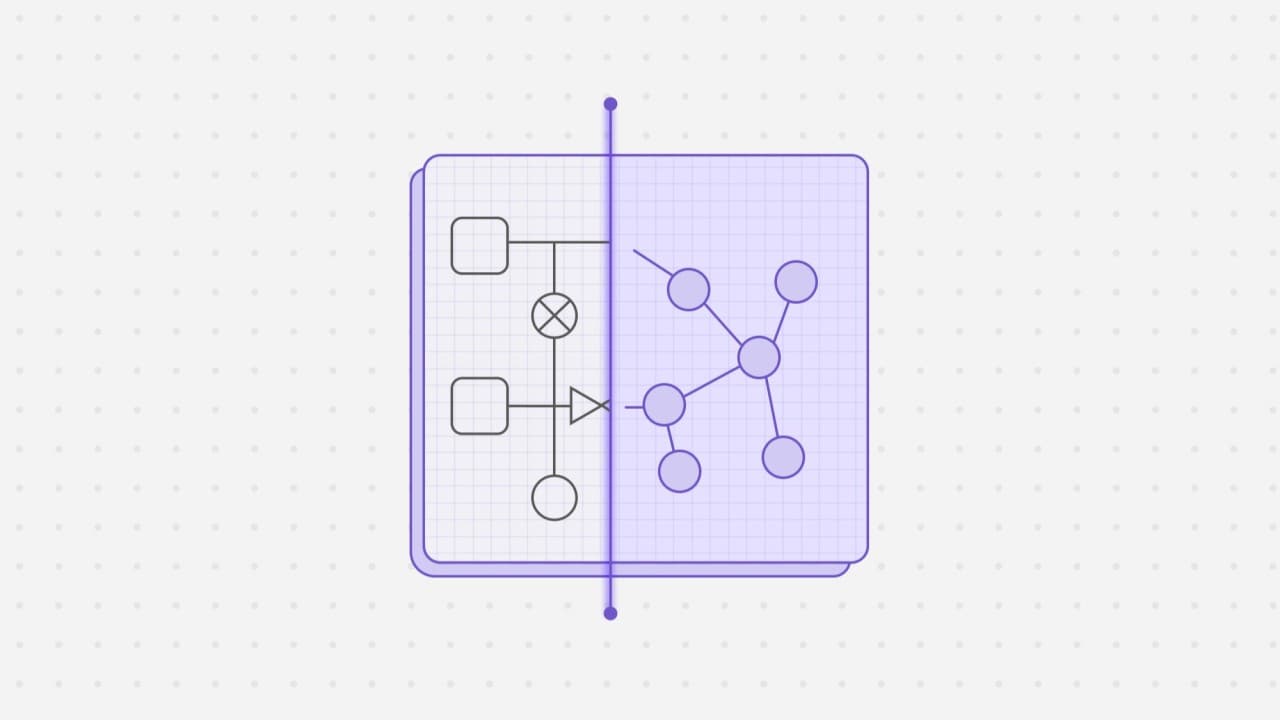
Every year, thousands of engineering teams make the same expensive mistake: they confuse the tool with the outcome.
There's a question that gets asked in data architecture meetings every week, in boardrooms, in Slack threads, in conference rooms filled with sticky notes and whiteboard diagrams:
"Should we add a graph database?"
It's the wrong question. And the fact that it's asked so reflexively — almost ritually — reveals something important about how the database industry has successfully conflated two things that are not the same:
A graph — a representation of how things in your world connect to each other.
A graph database — a specific, specialized piece of infrastructure for storing and querying that representation.
You almost certainly need the first one. You probably don't need the second.
What You're Actually Trying to Do
When a team asks about graph databases, they're usually trying to solve one of a small set of real problems:
- "We need to understand relationships between entities in our data — customers, products, transactions, events."
- "Our LLM keeps hallucinating because it lacks context about how things are connected."
- "We want to find fraud rings, supply chain dependencies, or influence networks that flat queries can't surface."
- "We're building a knowledge base our AI can reason over."
These are graph problems. They're about structure, relationships, and context. And they are completely valid.
But notice that none of these problems start with: "We want to write Cypher queries" or "We want to run a separate database cluster alongside our data warehouse" or "We want to spend six months modeling a schema in a proprietary graph query language."
Those are the consequences of choosing a graph database to solve a graph problem. They're side effects — not features.
The Graph Database Pitch Was Always About the Gap
Graph databases were invented to solve a real limitation: relational databases, built for tabular joins, become nightmarishly slow when you need to traverse relationships more than two or three hops deep. Want to find all the people connected to a fraud suspect within four degrees? SQL turns that into a catastrophic set of nested joins. A graph database traverses it natively.
That gap was real in 2007 when Neo4j was founded. It drove $325 million in funding in 2021 alone. It built an entire industry.
But the pitch was always implicitly bundled with something nobody asked for: a new database. A new infrastructure to provision. A new query language to learn (Cypher, GSQL, Gremlin, SPARQL — pick your flavor, they don't interoperate). A new ETL pipeline to move your data into the graph store. A new team skill set. A new operational burden.
And — the part that stings — a second copy of your data, now living in a system whose primary job is to tell you things about data you already have somewhere else.
The Stack You Didn't Ask For
Here's what a "production-grade graph database" implementation actually looks like in 2025, if you do it properly:
- 1. Extract your data from your existing sources — databases, data warehouses, document stores, APIs.
- 2. Transform it into a graph model — decide which things are nodes, which are edges, and what properties matter. This requires domain expertise, data modeling decisions, and usually several iterations.
- 3. Load it into your graph database of choice — maintaining that pipeline as your upstream data changes.
- 4. Learn the query language — Cypher if you're on Neo4j, GSQL for TigerGraph, Gremlin for JanusGraph/Neptune, and so on. These don't translate to each other.
- 5. Build your application on top of the graph — and now maintain two data systems in parallel: your operational source of truth and your graph representation.
- 6. Keep them in sync — because data changes. People change. Relationships change. Your graph goes stale the moment your ETL stops.
- 7. Operationalize it — monitoring, backup, scaling, licensing costs, and vendor lock-in that grows with every query you write in their proprietary language.
None of this is the business outcome you wanted. You wanted to understand how your data connects. You got a second career as a graph infrastructure engineer.
Meanwhile, What You Already Have
Here's the irony: most organizations already have the raw material for a rich, meaningful knowledge graph sitting in their existing data systems. Documents, databases, event logs, CRM records, product catalogs, support tickets — every one of these is dense with entities and relationships waiting to be surfaced.
The relationships are already there. A customer purchased a product. A transaction triggered a fraud alert. A document references a regulation. An employee owns a process that depends on a vendor.
The graph isn't missing from your data. It's missing from your ability to see it.
A graph database solves this by asking you to move your data and re-express it in a new model. But that's a workaround to a visibility problem, not a solution to it.
The Shift That Changes Everything
The smarter approach — the one that's quietly making standalone graph database vendors nervous — is to build the graph on top of where your data already lives, rather than extracting data into a new system designed for graphs.
This is what modern AI-native data platforms do. Instead of treating "graph" as a destination you ETL data into, they treat it as a lens you apply to data that stays where it is. The graph is constructed automatically — entities extracted, relationships inferred, embeddings built — as part of a workflow that runs against your existing sources.
The result: you get the outcome of a graph database — connected context, relationship traversal, knowledge-graph-powered search — without the infrastructure overhead, the proprietary query language, the ETL pipeline, or the second copy of your data.
You connected your sources. You described what matters. The platform built the graph for you, and it stays current as your data changes.
What This Means for Graph Database Companies
The market for standalone graph databases is being squeezed from both ends simultaneously, and it's worth being honest about that.
From above: every major hyperscaler — Amazon Web Services (AWS)(Neptune), Microsoft (Cosmos DB), Google (Spanner Graph), Oracle (23ai) — has added graph capabilities to their existing platforms. When you already run your data on AWS, "add Neptune" is a much easier sell than "adopt Neo4j ." Graph became a feature of the platforms you already pay for.
From below: AI-native platforms that build knowledge graphs automatically as part of intelligent pipelines are removing the need to interact with graph infrastructure at all. The graph is there, powering your RAG system, your search, your entity resolution — you just don't have to build it.
The pure-play graph database vendor is left occupying a narrower and narrower strip of the market: organizations with genuinely massive graph workloads, deep expertise, and specific performance requirements that nothing else meets. That's a real segment. But it's not the mass market the funding rounds of 2021–2023 were priced for.
The Right Question
So what should teams actually ask instead of "should we add a graph database?"
Ask: "What relationships in our data are we failing to see — and what would it cost to see them?"
Then follow the answer wherever it leads. Sometimes it leads to Neo4j. More often, it leads to a platform that can surface those relationships without asking you to become a graph infrastructure team.
The graph is the goal. The database is just one way to get there — and increasingly, it's not the fastest one.
Corvic AI is a data intelligence platform that automatically builds and traverses knowledge graphs on top of your existing data sources — no graph database required. Connect your data, describe what matters, and let the platform surface the connections.